
An underbite, also known as a reverse bite, is a common condition that causes many people to feel self-conscious and experience difficulty chewing. This condition not only affects facial aesthetics but can also lead to serious oral health problems if left untreated. Is there an effective solution to correct an underbite and achieve a balanced, harmonious smile? This article takes you through the impressive smile transformation journey of a young patient who regained her confidence through bracket-based orthodontic treatment. We will explore in detail the causes, diagnosis, treatment plan, and final results, giving you a clear understanding of the effectiveness of braces in correcting an underbite.

Article Content
The patient's initial condition
Our patient is a 16-year-old girl who came to the dental clinic seeking to improve her underbite and the gaps between her teeth. She expressed self-consciousness about her smile and wished to achieve a more harmonious and aesthetically pleasing appearance. Initial images clearly showed bite misalignment, with the lower front teeth protruding outward and significant spacing between the teeth.
Detailed Diagnosis from the Specialist
After a thorough clinical examination and analysis of X-ray images, the dentist provided a detailed diagnosis for this case:
- Class III skeletal relationship: The lower jaw is significantly protruded compared to the upper jaw.
- Edge-to-edge bite of the front teeth: The upper and lower front teeth meet edge-to-edge when the mouth is closed.
- Open bite of the lateral incisors and canines: There is a gap between the lateral incisors and canines when the jaws are fully closed.
- Lower dental midline deviated 1 mm to the left relative to the upper midline: The vertical axes of the two dental arches are misaligned.
- Left-deviated chin: Causing overall facial asymmetry.
- Tooth spacing: Gaps are present between teeth, including R32–33, 33–34, 42–43, 43–44, and 31–41.
- Slight proclination of the upper and lower front teeth: The front teeth tend to tilt outward.
- Tooth 12 has enamel-dentin fracture without pulp exposure: A minor lesion on the upper right lateral incisor.
Optimal Treatment Plan
Based on the patient’s desires and the diagnostic findings, the dentist developed an optimal treatment plan using metal braces. The primary goals of this plan are:
Correct the bite of the canines and first molars on both sides to achieve proper occlusal relationship.
Establish ideal overjet and overbite for the front teeth.
Completely close all gaps in the dental arches.
Align the lower dental midline with the upper midline to improve facial symmetry.
The treatment using metal braces was chosen for its effectiveness, durability, and cost-efficiency, making it suitable for a young patient’s condition.
Detailed Treatment Process
Metal Braces Treatment Process Typically Includes the Following Steps:
- Examination and X-ray Imaging: A comprehensive assessment of the oral condition, jawbone, and bite, followed by necessary radiographs such as panoramic (Panorama) and cephalometric X-rays.
- Dental Impression and Treatment Planning: Take dental impressions using alginate or 3D scanning technology, analyze the X-rays, and develop a detailed treatment plan.
- Bracket Placement: The dentist attaches brackets to the tooth surfaces and threads the archwire through them to apply gentle pressure, gradually moving the teeth into proper alignment.
- Periodic Check-ups: Patients visit the dental clinic as scheduled (typically every 3–6 weeks) for the dentist to replace the archwire or elastic bands, adjust tooth movement forces, and monitor treatment progress.
- Bracket Removal and Retention Phase: Once the teeth have reached the desired alignment, the brackets are removed. The patient will then wear a retainer to maintain and stabilize the treatment results.
Treatment Outcomes
After a consistent treatment process and adherence to the dentist’s instructions, the patient has achieved highly impressive results:
- All gaps in the dental arch have been completely closed.
- The bilateral occlusion has become balanced, with proper interlocking of the cusps, ensuring effective chewing function.
- The overjet and overbite of the front teeth have been corrected to normal levels, creating a harmonious smile.
- The midline between the two arches has been properly aligned, significantly enhancing facial symmetry.
- The post-bracket removal images show positive changes, delivering a confident and aesthetically pleasing smile for the patient.
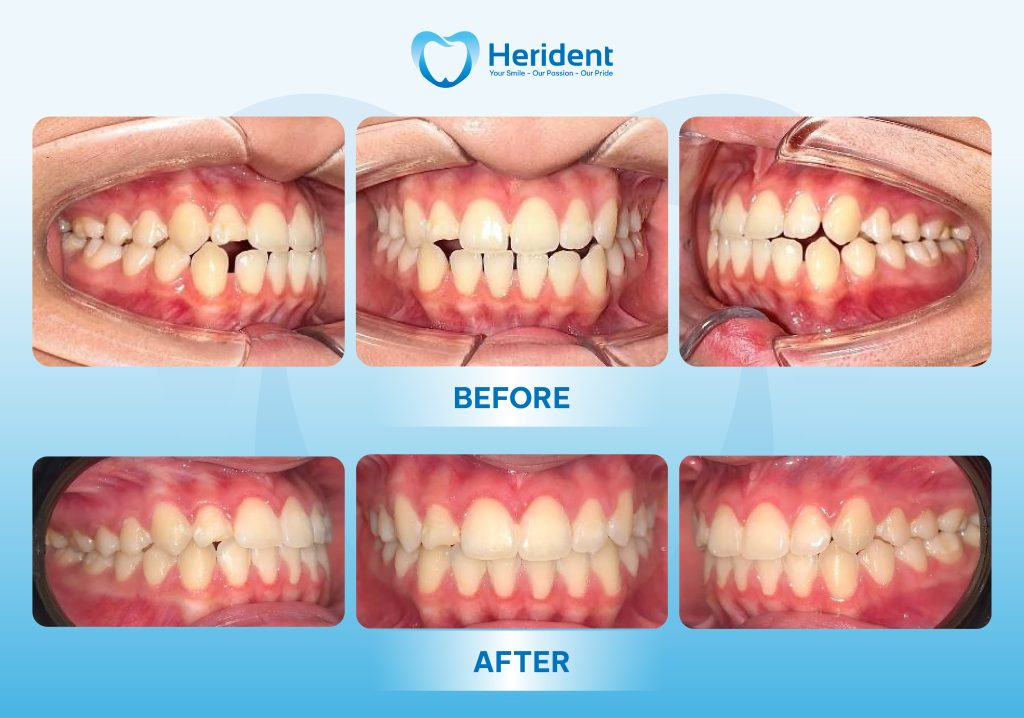
Before and After Treatment Comparison Images of the Patient
Advice and Important Notes
After completing the orthodontic treatment, maintaining the results is extremely important. The dentist advised the patient:
- Wear the retainer regularly as prescribed to prevent the teeth from shifting back.
- Undergo restoration for tooth #12, where enamel and dentin damage previously occurred, to ensure both aesthetics and function.
- Maintain good daily oral hygiene habits, including proper brushing and flossing, to protect long-term oral health.
- Schedule regular dental check-ups to allow the dentist to monitor and make necessary adjustments.
Conclusion
A clinical case of a 16-year-old female patient treated for underbite and spaced teeth using metal braces has demonstrated the outstanding effectiveness of orthodontic treatment in creating a beautiful smile. From correcting the malocclusion and midline deviation to closing gaps between teeth, all issues were addressed, resulting in facial harmony and optimal chewing function. This process not only requires high technical expertise from the dentist but also patience and cooperation from the patient.

Herident Dental Clinic – A Trusted Orthodontic Center in Hanoi
Herident proudly stands as a specialized center for orthodontics, porcelain restorations, and implants, staffed by experienced dentists, equipped with modern technology, and following internationally standardized treatment protocols. We continuously update the latest advanced methods to deliver the best results for each patient. If you are experiencing issues such as underbite, spaced teeth, or any other bite misalignment, don’t hesitate to contact Herident for a consultation and direct examination. Schedule your appointment today to begin your journey toward a confident and perfect smile!


Related Articles
Trẻ hô nhiều, cắn chìa: Invisalign hỗ trợ điều trị như thế nào?
Hô ở trẻ không phải lúc nào cũng xuất phát đơn thuần từ việc răng cửa trên chìa ra phía trước. Trong nhiều trường hợp, tình trạng này còn liên…
View MoreViêm tủy răng: Những dấu hiệu cảnh báo không nên bỏ qua
Viêm tủy răng có thể bắt đầu bằng những biểu hiện khá quen thuộc như ê buốt, đau khi ăn nóng lạnh hoặc đau tự phát. Nếu không được phát…
View MoreTrám răng là gì? Khi nào cần trám răng và quy trình thực hiện
Răng có thể bị tổn thương do nhiều nguyên nhân như sâu răng, mẻ răng, sứt răng, mòn răng hoặc mất một phần mô răng. Khi phần mô bị tổn…
View MoreChăm sóc răng khi niềng: Những lưu ý giúp hạn chế sâu răng và viêm nướu
Chăm sóc răng khi niềng đúng cách giúp hạn chế sâu răng, viêm nướu, hôi miệng và bảo vệ kết quả chỉnh nha. Tìm hiểu những lưu ý quan trọng…
View MoreRăng mỏng yếu, ê buốt liên tục: Đừng bỏ qua nguy cơ thiểu sản men răng
Men răng là lớp ngoài cùng của răng, có vai trò bảo vệ ngà răng và giúp răng chịu được lực ăn nhai cũng như các tác động từ môi…
View MoreChăm sóc sau nhổ răng khôn: Những lưu ý giúp vết thương hồi phục ổn định
Nhổ răng khôn là một thủ thuật có can thiệp vào mô răng và mô xung quanh, vì vậy giai đoạn chăm sóc sau nhổ có vai trò quan trọng…
View More